Back to Blog Home Page

Last updated: January 27, 2026
Originally published: May 27, 2025
Enterprise hiring doesn’t happen on a small scale. When you’re managing thousands of applicants each year, staying organized—and hiring well—requires a powerful applicant tracking system (ATS) built for complexity. It’s why 99% of Fortune 500 companies rely on an ATS to manage and track candidates.
With the right ATS in place, recruiters can quickly search resumes, centralize candidate data, and turn hiring activity into actionable insights. The result? Less manual sourcing, faster decisions, and more time spent connecting with top talent—not parsing resumes and chasing paperwork.
But what exactly is an ATS? How is it different than a Human Resources Information System (HRIS)? And what are the benefits?
In this blog, we’ll dive into the questions that matter most and give you the resources to determine what you need in an ATS and how it can help you scale.
What is an Applicant Tracking System?
At a baseline, an applicant tracking system helps companies organize candidates for hiring and recruitment purposes. These systems allow businesses of all sizes and industries to collect candidate information, organize prospects based on experience and skill set, and filter them to determine the best fits for each open role.
But today’s hiring challenges demand more than a standalone system. The most effective applicant tracking systems work as part of a broader talent acquisition ecosystem. When paired with tools like candidate relationship management (CRM) software, teams can keep candidates engaged long after initial screening—building talent pipelines that last beyond a single role.
What’s The Difference Between an Applicant Tracking System and a Human Resources Information System?
Not all HR technology is meant to do the same job. And knowing which systems support which goals is essential to gain momentum and continued velocity in your hiring efforts and across your employee lifecycle.
An applicant tracking system is purpose-built for recruiting. It supports teams in attracting candidates, managing applications, coordinating interviews, and moving qualified talent efficiently through the hiring funnel—with a focus on speed, visibility, and informed hiring decisions. Think of this as your candidate lifecycle support team.
An HRIS, by contrast, is designed to manage the employee lifecycle after the “you’re hired.” It typically handles payroll, benefits administration, employee records, and ongoing HR operations.
While some HRIS platforms include light recruiting capabilities, they aren’t built to support the scale, complexity, or candidate experience required for modern hiring at the enterprise level. That’s why many organizations rely on a dedicated applicant tracking system to power hiring—and an HRIS to manage everything that follows afterward.
Learn more about how an ATS and an HRIS work together to help teams work better.
What Features Should Enterprises Look for in an ATS?
Not every applicant tracking system is created equal. And for enterprise organizations, that distinction matters.
Managing high-volume, high-stakes hiring requires a comprehensive ATS built to handle scale, complexity, and constant change—without sacrificing candidate experience or team efficiency.
A modern ATS simplifies the recruiting process for talent acquisition teams by using automation to help TA pros efficiently identify, reach out to, interview, and advance qualified candidates. Because when one job posting can attract thousands of candidates—regardless of whether they are qualified for the role—relying on your team to manually weed through resumes and parse out the qualified talent simply isn’t feasible.
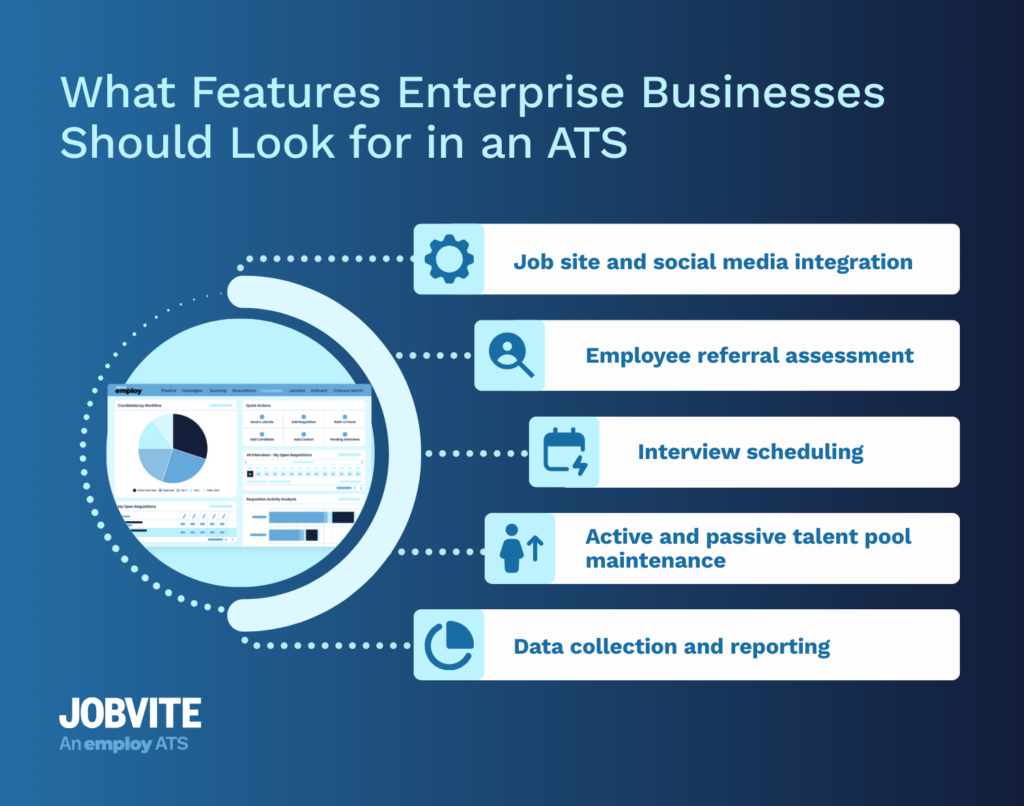
Beyond automation, a strong enterprise applicant tracking system should enable your team to manage high-volume hiring with clarity—connecting workflows, people, and data across every stage of the recruiting process.
- Post job openings across career sites and job boards.
Publish roles quickly and consistently across multiple channels from a single system, ensuring job information stays accurate and up to date everywhere candidates search.
- Connect with candidates on social platforms like LinkedIn.
Reach and engage active and passive talent directly from the ATS, making it easier to build pipelines and meet candidates where they already are.
- Track employee referrals and internal mobility.
Capture referrals, internal applicants, and movement between roles in one place—giving teams better visibility into internal talent and referral performance.
- Schedule interviews with speed and consistency.
Reduce back-and-forth by automating interview scheduling, coordinating calendars, and keeping recruiters, hiring managers, and candidates aligned.
- Rediscover top talent silver-medalist candidates.
Surface qualified candidates already in your database to fill new roles faster—without starting every search from scratch.
- Access real-time insights to support data-driven hiring decisions
Monitor pipeline health, time-to-hire, and candidate flow in real time, helping leaders identify bottlenecks, optimize processes, and plan with confidence.
How Does a Top ATS Work?
While no two applicant tracking systems will work in the exact same manner, teams can generally expect their hiring workflows to follow a common high-level framework:
- Once the talent acquisition team has secured an adequate pool of applicants, they can tag and label candidates based on resume information.
- From here, recruiters can filter based on skillsets and job descriptions to find strong-fit candidates for open roles. They can also mitigate implicit bias by using a bias blocker that removes any identifying information from the resume.
- The ATS can then enable recruiters to communicate with candidates and schedule interviews.
- Hiring team members submit feedback immediately following interviews, adding notes about each candidate and how well they fit the needs of the req. These scores and notes allow hiring decision makers to evaluate prospects in a bias-free manner and advance ideal applicants quickly.
Note that the process will look very different between enterprises using a modern versus a legacy ATS. For instance, applicant tracking systems that use the latest technology—think AI solutions like Jobvite’s AI Interview Companion—can scan resumes, provide recommended interview questions, and streamline otherwise cumbersome processes.
What are the Benefits of an Applicant Tracking System?
Qualified candidates per role. Engagement rates. Candidate experience. These are just some of the metrics that your team is responsible for tracking—metrics that can see significant improvement with the support of the right applicant tracking system.
But the benefits of an enterprise-level ATS go far beyond that, to include:
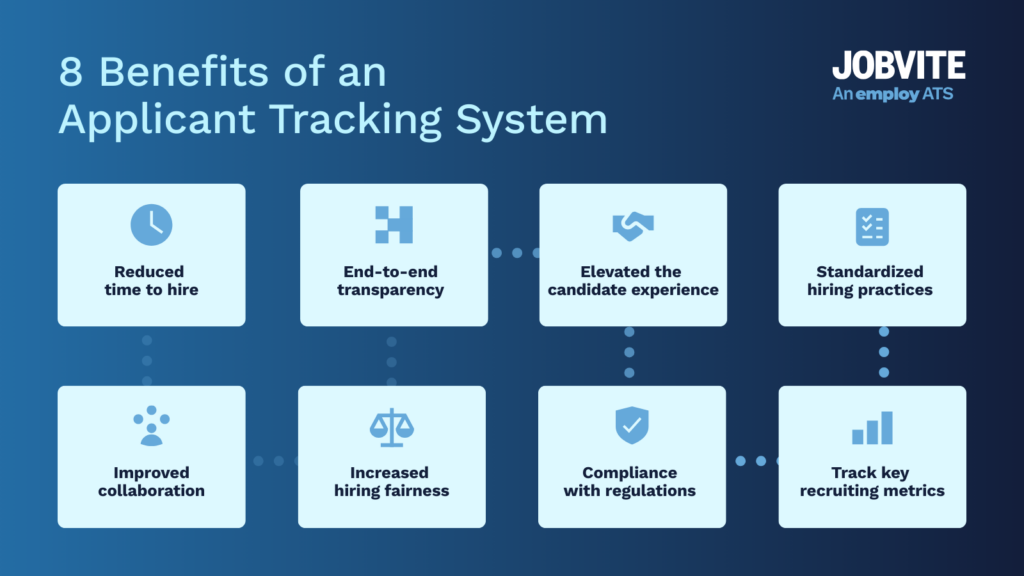
1. Reduce time to hire for critical roles
According to Employ’s 2025 Benchmarks Report, the average time to hire increased from 45.7 days in 2024 to 46.2 days in 2025. And while enterprise orgs did beat this benchmark—reporting 35.4 days on average—room for improvement remains. Especially for teams still relying on outdated systems or manual processes.
With advanced applicant tracking systems like Jobvite’s ATS, talent leaders and operations managers get a holistic view of their entire team’s pipeline progress in real time, allowing them to share insights and make critical adjustments as needed. With clear metrics in hand, these TA pros can reduce bottlenecks and advance candidates through the pipeline to reduce time to hire for each of their open reqs.
2. Improve visibility and collaboration for your hiring team
It’s not just your talent acquisition efforts that benefit from an ATS. Hiring managers can also use them to ensure they have full visibility into how many people have applied for their roles, how many proactively sourced candidates recruiters have found, and where each of these individuals resides in the hiring funnel.
As job seekers move from one interview stage to the next, hiring managers can easily compare candidates right in the ATS and extend offers to their preferred prospects.
3. Leverage end-to-end transparency with an integrated ecosystem
Direct integrations between essential recruiting software and HRIS enable talent acquisition teams to sync data seamlessly across their tech stack. Integrations empower a transparent end-to-end recruiting process, providing stakeholders with a complete, real-time view of pipeline progress and ensuring critical candidate data is shared with other important tools for business growth.
Plus, these direct connections speed up tasks across the recruiting funnel—from writing inclusive job descriptions and sharing automated interview updates internally to hosting candidate assessments and conducting background checks.
4. Increase hiring fairness and reduce bias
Bias remains one of the most persistent challenges for talent acquisition teams. Even when unintentional, bias can have real consequences—for candidates and for organizations working to build equitable, compliant hiring practices.
A strong applicant tracking system will include features like bias blocking, which removes identifying information from applications so candidates are evaluated based on skills and qualifications.
Bonus: If you’re evaluating AI-powered tools alongside your ATS, transparency matters. Look for solutions built with clear governance and responsible AI principles, ensuring automation supports fair decision-making rather than introducing new sources of bias.
5. Elevate the candidate experience
According to the 2025 Employ Recruiter Nation Report, 35% of recruiters are focusing on improving the candidate experience—up from 28% in 2024. And we expect that trend to continue on an upward trajectory. The impact of the candidate experience on an employer’s brand and reputation has never been more pronounced. But with the support of the right ATS? You can keep your candidate experience and your brand in tip-top shape.
An ATS can significantly improve the overall recruitment experience of both your hiring managers and candidates, in areas such as:
- Supporting speedy internal and external communication.
- Providing channels for candidates to give feedback.
- Automatically sending notifications and updates based on custom workflows.
- Offering a centralized portal for candidates to view hiring updates.
- Enabling personalized two-way communication at any stage of the hiring funnel.
6. Compliance with regulations
A critical yet often-overlooked aspect of the hiring process is compliance with local and, for larger businesses, international hiring laws.
This is especially important for enterprise-sized organizations that hire hundreds, if not thousands, of employees per year. With that much recruitment data and international hiring regulations to keep track of, information can easily slip through the cracks.
An ATS, working in tandem with data-driven analytics, keeps all the insights you need—and discards the information you don’t, such as duplicate records—to ensure reporting accuracy and avoid penalties.
7. Standardize hiring practices
When it comes to hiring globally, keeping only the most relevant and qualified candidates in your talent pool is essential to efficient and accurate hiring. That’s where having a standardized hiring practice can help.
The right ATS can:
- Create custom workflow templates to enable consistent processes.
- House data that’s used across the team, such as interview questions and follow-up timelines.
- Assign team members to tasks and notify them automatically.
- Integrate with onboarding systems to ensure applicants transition to new hires successfully.
8. Track key recruiting metrics
You can’t improve your hiring process without visibility into the key metrics that show where you currently stand. Leading applicant tracking systems offer built-in analytics and real-time dashboards that reveal where your team is outperforming, where you’re on track, and where there’s room to improve.
How To Start Using an Applicant Tracking System
Recruiting top talent is one of the most critical—and complex—challenges facing growing businesses today. With the right tools in place, you can turn a time-consuming, high-stakes process into a streamlined, strategic advantage.
An ATS empowers your hiring teams to work smarter, stay organized, elevate your talent acquisition strategies, and deliver an outstanding candidate experience—all while helping your business scale more efficiently.
Now that you have a clearer understanding of what an ATS can do, it’s time to take the next step. Partner with your HR, recruiting, and tech leaders to evaluate your organization’s hiring needs, explore the ATS landscape, and identify a solution that aligns with your goals and ideal tech stack.